
Call For a Consultation (305) 373-4400
Securities Fraud Lawyer
Trusted Securities Fraud Attorney
When the SEC or DOJ Starts Asking Questions About Your Trades
A letter from the SEC references your trading account. A subpoena lands on your desk. Two federal agents want to discuss your client’s investment losses. However, with a trusted Miami securities fraud attorney who can help you understand what the government may already know and how your response could affect what follows.
With more than 40 years of criminal defense experience, Barry M. Wax is an experienced Miami securities fraud lawyer who understands that prosecutors and SEC staff may spend months building a file before the person under investigation learns about it. An experienced Miami federal investigation lawyer can examine the evidence, determine where the case may be headed, and help you decide how to respond.
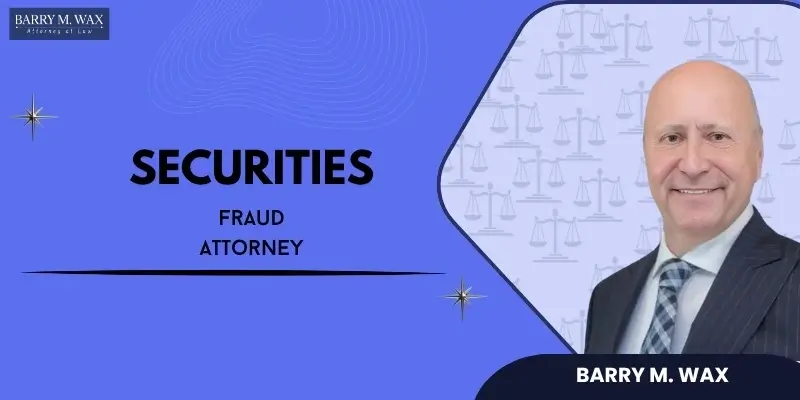
Barry M. Wax is admitted to practice in four federal district courts across Florida, Texas, and Michigan, as well as the United States Court of Appeals for the Eleventh Circuit. He works to determine what evidence exists and where a case is likely headed before deciding how to respond.
That groundwork is what turns a defense from reactive into deliberate: a documented record, careful silence where it counts, and a strategy built before a grand jury convenes rather than assembled after an indictment already carries your name.
Reach out and tell us what you have received the letter, subpoena, or agent’s card—and we can explain what it means and what may happen next.
| 40+ Years of Criminal Defense Experience | AV Preeminent Since 2007 | Super Lawyers 2017–2026 | Avvo Rating 10.0 Superb |
Federal Securities Charges We Defend
Securities fraud covers a wide range of federal charges, and prosecutors may bring several charges in a single indictment. Whether you are a broker, fund manager, corporate executive, or individual investor caught up in someone else’s alleged scheme, understanding the full scope of the allegations is essential before responding.
Many securities cases overlap with other financial offenses. The firm’s guide explaining what qualifies as a white-collar crime provides additional information about the broader category of charges that may accompany a securities-fraud investigation.
Our securities fraud attorney defends federal securities and investment-fraud matters involving:
- Insider trading: Trading securities, or tipping someone else, based on material nonpublic information. These cases may turn on phone records, messages, trading histories, and evidence concerning the relationship between the alleged tipper and recipient.
- Ponzi and investment-fraud schemes: Using new investor money to pay earlier investors while claiming that payments represent legitimate returns. Prosecutors often build these cases around bank, brokerage, and accounting records covering several years.
- Pump-and-dump and market-manipulation allegations: Artificially inflating a security’s price through allegedly false or misleading statements before selling into the increase. Social-media posts, online promotions, emails, and message-board activity may become evidence.
- Unregistered securities offerings: Selling securities or acting as a broker-dealer without a registration required by federal law. These allegations may accompany broader fraud claims rather than appearing alone.
- Investment-adviser fraud: Alleged breaches of duties to clients involving undisclosed fees, conflicts of interest, misappropriation, or misrepresented returns.
- Accounting and financial-statement fraud: Allegations involving falsified filings, misstated earnings, or misleading corporate disclosures. Executives, controllers, accountants, and other participants may face scrutiny based on the same filings.
- Commodities and cryptocurrency fraud: Alleged schemes involving commodities, futures contracts, digital assets, or securities. Depending on the facts, prosecutors may rely on securities, commodities, wire-fraud, money-laundering, or conspiracy statutes.
- Wells notice responses: Representation after SEC staff informs a person or business that it has made a preliminary determination to recommend an enforcement action.
- Federal wire-fraud and conspiracy charges: Additional counts prosecutors may bring when the alleged securities scheme involves electronic communications or an agreement between multiple participants.
This is not an exhaustive list. If you are facing a federal investigation tied to an investment, security, commodity, digital asset, or financial account, contact the firm to discuss where the matter may fit.
What a Federal Securities Fraud Conviction Can Cost You
A federal securities-fraud charge may be accompanied by wire-fraud, mail-fraud, conspiracy, money-laundering, obstruction, or false-statement charges.
A conviction under 18 U.S.C. § 1348 can result in up to 25 years in federal prison. A court may also impose fines, restitution, forfeiture, supervised release, and other consequences depending on the charges and facts.
If the SEC is pursuing a parallel civil enforcement matter, the person or business may also face civil monetary penalties, disgorgement, injunctions, and a possible bar or suspension from participating in the securities industry.
A plea agreement or Wells submission is not automatically the right first move. A statement provided to SEC staff may also affect a related criminal investigation, and information produced during the civil matter may become relevant to federal prosecutors.
Every decision—from the first document produced to a potential plea negotiation—should account for both civil and criminal exposure when parallel proceedings exist.
The firm’s overview of recent federal sentencing guideline amendments explains how federal sentencing rules may influence the consequences of a conviction.
How We Build a Federal Securities Fraud Defense Before Charges Are Filed
Every securities-fraud matter starts with determining where the investigation stands before responding. That approach comes from decades of watching federal matters unfold from the first subpoena through trial and sentencing.
- We identify the agencies and proceedings involved. We determine whether the matter involves an SEC inquiry, a DOJ criminal investigation, or parallel civil and criminal proceedings.
- We assess your status. We evaluate whether you appear to be a witness, subject, target, respondent, or potential defendant. The firm’s guide to the differences between a target, subject, and witness in a federal investigation provides additional context.
- We review prior productions and statements. We examine documents already produced under subpoena and statements made before counsel became involved.
- We prepare Wells submissions when appropriate. When SEC staff issues a Wells notice, we address the proposed charges, disputed facts, legal issues, relevant evidence, and litigation risks.
- We coordinate the civil and criminal strategies. We consider how information provided to SEC staff could affect a related DOJ investigation and how the criminal investigation may affect the SEC matter.
- We prepare for litigation from the beginning. We develop a record that can support negotiations, motions, hearings, or trial if charges are filed.
- We remain personally involved. Barry M. Wax handles the matter directly rather than transferring responsibility to a junior associate after the initial consultation.
Contact us to learn more about how our securities fraud attorney may be able to help with your matter.
The Two Federal Laws Behind Many Securities Fraud Cases
Federal securities-fraud prosecutions may rely on 18 U.S.C. § 1348, which prohibits knowingly executing or attempting to execute certain schemes involving securities or commodities.
The statute applies to completed and attempted schemes and authorizes a maximum prison sentence of 25 years. The government must still prove the applicable statutory elements beyond a reasonable doubt.
A second important statute is 18 U.S.C. § 3301, which establishes a six-year limitations period for securities-fraud offenses covered by the statute. Other charges arising from the same investigation may be governed by different limitation periods.
This information reflects federal law as of October 2026.
How the Wells Process Can Affect an SEC Investigation
A Wells notice informs the recipient that SEC staff has made a preliminary determination to recommend that the Commission file an enforcement action or institute a proceeding. It also identifies the potential securities-law violations and gives the recipient an opportunity to make a voluntary submission.
According to the SEC Enforcement Manual, absent timing constraints, staff generally should allow a four-week period for a Wells submission. The notice controls the actual deadline, and requests for extensions should be submitted in writing.
A Wells submission can address disputed facts, legal elements, exculpatory evidence, adverse precedent, litigation risks, and policy concerns. However, the SEC may use statements in the submission in a later action, so the submission should be prepared with any parallel criminal exposure in mind.
Federal Securities Fraud Cases in Miami
Federal securities-fraud investigations involving Miami, Florida, may involve the SEC, FBI, Department of Justice, Internal Revenue Service Criminal Investigation, or other federal agencies.
Federal criminal cases brought in Miami generally proceed through the United States District Court for the Southern District of Florida. The Southern District of Florida’s Miami courthouse directory identifies the Wilkie D. Ferguson Jr. United States Courthouse at 400 North Miami Avenue.
Not every investigation results in charges, and not every Miami securities case will be assigned to the same courthouse or judge. The subpoena, charging document, or court notice should be reviewed to confirm where a particular proceeding will occur.
FAQs About Miami, FL Securities Fraud Law
Do I need an attorney now, or can this wait?
If you have received an SEC subpoena, Wells notice, grand jury subpoena, or request to speak with federal agents, obtaining legal advice promptly can give your attorney more time to assess your status, preserve evidence, review deadlines, and communicate with investigators before you respond.
What is the difference between an SEC investigation and a DOJ criminal case?
An SEC enforcement investigation is civil and may result in monetary penalties, disgorgement, injunctions, or industry bars. A DOJ prosecution is criminal and may result in imprisonment, fines, restitution, forfeiture, and supervised release. The proceedings can occur at the same time and may involve overlapping evidence.
What is a Wells notice, and what should I do if I receive one?
A Wells notice informs you that SEC staff has made a preliminary determination to recommend an enforcement action. It gives you an opportunity to submit a written or video response addressing the proposed recommendation. Review the notice’s deadline and obtain legal advice before preparing the submission.
Can I be charged with securities fraud if the alleged scheme never succeeded?
Yes. Section 1348 applies to knowingly executing or attempting to execute a covered fraudulent scheme. The government must still prove the required elements, but an unsuccessful attempt may be prosecuted under the statute.
What court hears federal securities fraud cases filed in Miami?
Federal securities-fraud prosecutions filed in Miami generally proceed in the United States District Court for the Southern District of Florida. The specific courthouse, judge, and courtroom depend on the case assignment and the information listed in the court documents.
Can an SEC investigation lead to a federal criminal case?
Yes. SEC staff may refer information suggesting potential criminal conduct to the Department of Justice or another law-enforcement agency. Civil and criminal investigations may also proceed simultaneously.
How long does the government have to bring a federal securities fraud charge?
Section 3301 generally establishes a six-year limitations period for securities-fraud offenses covered by that statute. Different charges or circumstances may be governed by different deadlines, so the applicable limitations period must be evaluated based on the specific allegations.
Should I speak with SEC examiners or FBI agents without an attorney?
You have the right to seek legal advice before participating in a voluntary interview. Statements to SEC staff or federal agents may affect a civil or criminal investigation, so understand the purpose of the interview and your legal position before answering questions.
Can I face insider-trading allegations if I shared information but did not trade?
Potentially, yes. Insider-trading allegations may involve a person who provides material nonpublic information to someone else. Liability depends on the source of the information, the relationship between the parties, the purpose of the disclosure, any benefit received, and other facts.
What does it cost to begin a securities fraud defense?
The cost depends on the investigation’s complexity, the volume of records, the agencies involved, and whether parallel civil and criminal matters exist. The firm explains the proposed fee arrangement during a confidential consultation before representation begins.
Do I need a Miami securities fraud attorney if the investors live outside Florida?
Possibly. Federal venue can depend on where alleged transactions, communications, acts, or effects occurred. Investors’ locations are only one consideration, so an investigation may proceed in the Southern District of Florida even when some investors live elsewhere.
What if I spoke with SEC staff or an FBI agent before hiring an attorney?
It may not be too late to obtain help. An attorney can review what was said or produced, identify potential issues, and advise you about future communications, document requests, interviews, and defense strategy.
Talk to a Dedicated Miami Securities Fraud Attorney Before Responding
If a subpoena, Wells notice, or agent’s business card is sitting on your desk, the response deadline may already be running. What you do during the next several days can affect the investigation’s direction.
Barry M. Wax has more than 40 years of criminal defense experience and is admitted in four federal district courts, as well as the United States Court of Appeals for the Eleventh Circuit. He begins by determining what the government has requested, what evidence may already exist, and what response protects your interests.
The Law Offices of Barry M. Wax represents individuals, executives, financial professionals, advisers, and businesses facing federal securities-fraud investigations. Contact the firm to schedule a confidential consultation before responding to investigators or producing requested records.
Serving Miami and South Florida
When you are facing a securities-fraud investigation in Miami or elsewhere in South Florida, your freedom, career, professional reputation, and financial interests may all be affected. The Law Offices of Barry M. Wax provides direct representation from an attorney who has practiced criminal defense since 1985 and personally handles the matters entrusted to the firm.
Based at 701 Brickell Avenue, Suite 1550, in Miami, the firm represents clients throughout Miami-Dade County and South Florida, including Brickell, Miami Beach, Aventura, Fort Lauderdale, Weston, Broward County, Monroe County, and Palm Beach County.
The firm represents brokers, financial advisers, executives, fund managers, accountants, licensed professionals, investors, businesses, witnesses, subjects, and targets facing SEC inquiries, Wells notices, grand jury subpoenas, insider-trading allegations, investment-fraud investigations, parallel proceedings, and related federal charges.
Miami, FL Securities Fraud Law Additional Resources:
- What Counts as Fraud? Six Federal Offenses You Should Know About
- What Is the DOJ Focusing on Now? Seven White-Collar Offenses You Cannot Afford to Ignore
- Federal Conspiracy Charges and Defense Strategies
- How to Know if You Are Under Federal Investigation
- Questions to Ask When Hiring a Miami Federal Defense Attorney
Law Offices of Barry M. Wax Office Location
Copyright © 2026 Law Offices of Barry M. Wax. All rights reserved.
Digital Marketing By 
*Images are obtained under license from Canva and other third-party stock image providers, with attribution included where required.